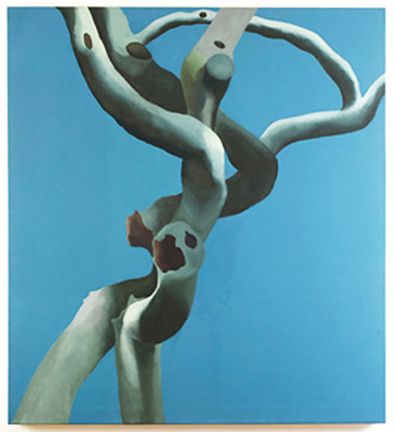
Mary Hrbacek, Twisted Naxos, 2016. Charcoal on paper, 22 x 30 in.
Entwined
Paintings by Mary Hrbacek
CREON Gallery, April 6 – 30, 2011
Nature is anything but natural in the vision of artists. They use it to describe both the illimitable world and their own psychic landscape. Depicting nature is way to make sense of what is human.
This is true in the case of Mary Hrbacek’s paintings, seen recently at CREON Gallery. She paints trees, or more precisely sections of their trunks and limbs, seen from below. Hrbacek sets her trees against solid blue, silver or graduated expanses that all read as sky. The branches are leafless and the bark has been reduced to a smooth, skin-like surface. Most notably, the trees are both abstracted in form and humanized in feeling.
By taking on characteristics of the human body, Hrbacek’s trees surrender some of their arboreal identity and seem moved by emotion. Tree limbs twist and strain, giving us the sense that there is a human being or consciousness merged with it. The painting Entwined, with its curving branches, seems to be a dancing in a disco contrapostpo. Hanging Suspended is a legs-up figure whose torso melds with a tree, a distant echo of Goya’s image of a war-time atrocity.
Breasts appear to be emerging from some of the trees, and there are hints of other aspects of human anatomy. And the limbs seem human in their reaching and at times agonized gestures.
We can fairly ask, what has animated the phenomena painted here? A constellation of meanings suggest themselves. A personal, fervid surrealism is inherent in these anxious, dream-like, hybrid beings. There is an emphasis on the female body as an icon, and by extension, a surrogate for women’s collective experience. Allegory is inherent in Hrbacek’s approach, a kind of extended metaphor, in which a psychological drama is performed at a symbolic remove. A case of possession strongly comes to mind: a human captured by a tree or turning into one, like Daphne in Greek mythology, becoming a laurel tree to escape the god Apollo’s lustful pursuit.
As a source of the Daphne image, Hrbacek cites Ovid’s Metamorphosis, the Roman poet’s mock-epic of love and transformation. The self, capable of concealing and dramatizing its mutable identity, is central to these paintings. Looking up at the trees and depicting them against a sheer sky is a heroicizing act, exclusive in its focus. We can look to Georgia O’Keefe’s work as a precedent here. Relevant as well might be the naked expressionist self-portraits of the Austrian nonagenarian Maria Lassnig. Like these artists, Hrbacek paints nature and the body with a highly realism, turning the observed into something personally expressive.
Hrbacek’s Light Search is prime example of this tendency to create from the natural a theater of the self, making a character out of a tree, with hand-like branches extending beyond the frame. In Counterparts, the pale limbs, shading to a deep vermillion, bulge like human legs. While in Williamsburg Dancer the energy is tightly contained, a metallic sheen delineating a lava-like surface and extended arms.
John Mendelsohn