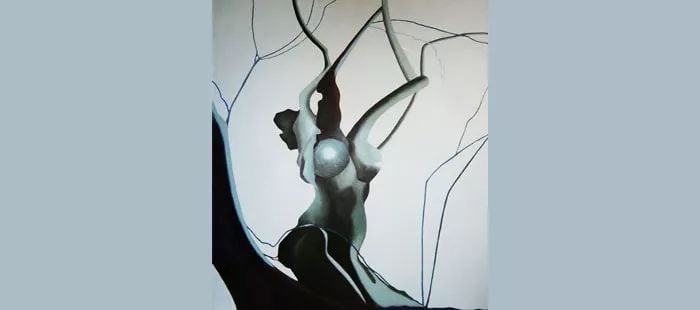
Maybe the first thing to be known about Mary Hrbacek is that she has a house high up in northern Vermont, about twenty miles from the Canadian border. It is an important fact influencing her life as an artist as someone intent on resurrecting a deeper view of trees through the experience of intense observation.In both paintings and works on paper, Hrbacek shows us both a dedicated passion to render the image as factually as possible and an equally intense desire to transform trees into living evidence of both the inspired ways of nature and, at times in a unique vision, into human figures.
Rendering a tree today poses difficulties hard to surmount; the history of Western painting has a tendency of getting in the way. But, likely because of her long experience in detailing nature, Hrbacek never falls prey to idealism of a lesser sort. Instead, she uses her imagination to discover people locked into the trees she photographs; she paints these tree people as defined by the curves and delineations of the branches. As a result, even the figures contained in her expertly described trunks and branches result from the sustained merger between the imagination and reality. Strikingly, Hrbacek finds trees that do in fact look like people, so that they occupy the tree forms convincingly, without violating her subjects.
Hrbacek’s charcoal drawings on paper really function as one of a kind. There is a specificity to the forms, and a density to the charcoal, that gives the trees a hallucinatory reality. The intensity of the perception is so strong it boggles the imagination, which is in fact what Hrbacek has set out to do. Indeed, these forms, while not the same in scale as their actual counterparts, nonetheless project the inner as well as the outer facticity of treeness. The artist, I think, has set out to communicate in nearly mythic terms the way a tree grabs hold of the imagination, so that the metaphorical phrase “the tree of life” possesses a realism that is intuitively correct. One hesitates to go farther than that in assessing the drawings, since they actually are imaginary constructs based on actual examples of nature. Perhaps this is exactly what Hrbacek has in mind, namely, a tension between what we see and what we feel about the object of our vision. Within this tension exists the living heart of the natural forms, which are by turns knobby, undulating, ramrod straight, and fractal. If there is truly a moment in which the viewer and the thing seen merge, it would likely occur on seeing Hrbacek’s trees, which are based on the moment when the eye makes contact with the item its gaze falls upon.
Just as interesting as the charcoal drawings are the paintings in which people seem to be locked into the form of a tree: in Seizing Venus, for example, the small branches emanating from Venus’s dress look like they are imprisoning her. Her face is in shadow and turned away from us, and the dress merges with lighter and darker portions of the tree trunk itself. But it is wrong to see the goddess as disguised. Her head and body conform perfectly to the shape of the tree as it has been constructed, leaving us with the stunned recognition that a fact of nature can be made so completely, so seamlessly into a human body. It is true that the artist has made a specialty of trees, and that she has invested them with the general energies of a sharply realized gestalt. Sometimes the intricacies of the image add to the general feeling of genuine integrity; sometimes the details make the shape of the tree memorable past words. Hrbacek regularly shows us how to grasp the subtleties of nature: by focusing so intently on the image it takes on a life of its own. This should happen in all art but rarely does, so we are lucky to have found someone who constructs the truth of trees with such remarkable accuracy.
Jonathan Goodman
Jonathan Goodman is a writer and teacher based in New York City. He has written for ARTnews, Art in America, and Sculpture, among other publications. He is currently teaching contemporary art culture and thesis writing at Pratt Institute. In pursuit of articles on Chinese art, he has been to Mainland China five times.