Mary Hrbacek at Paris Koh Fine Arts in New York City by Jonathan Goodman
Mary Hrbacek, a specialist in the rendering of trees, put on a very good show that consisted mostly of paintings and a couple of drawings. She shows a remarkable exactitude in her art, which discloses the specificities of nature. At the same time, one often finds human faces and bodies in the particular arboreal examples she represents-indeed, some of the pleasure of the show is experienced by the viewer’s finding human forms in Hrbacek’s compositions. We are now at a time when our relationship with nature is close to disastrous, so Hrbacek is brave to return to themes of nature that sustain our interest and, hopefully, motivate us to do something about the ecological state of the planet. The urgency to act is not specific to the paintings or drawings, but Hrbacek’s care in detailing trees amounts to a call for change.
Usually, of course, we do not associate natural imagery with political expression. Yet the state of the earth has become so precarious that Hrbacek’s art inevitably takes on a social dimension. Political art has mostly failed in America; it tends to be strident, literal, and lacking in imagination. So the graceful paintings encountered in this show tend to politicize their audience by implication – perhaps a better strategy for change.
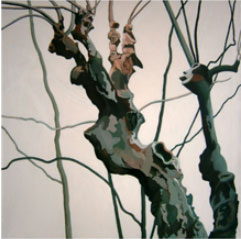 Mary Hrbacek, Fierce Affection, 2014, acrylic on linen,
40” x 40”
As strong as these paintings are, Hrbacek’s endeavors exist in a contemporary art world that takes little interest in nature especially in the conceptually oriented art world of New York City. But the artist, who has a family home in northern New England, owns her interest in trees in the sense she was surrounded by nature as a child. Still, it is hard to place her work within current artistic activities, although there is a small coterie of good painters who remain bent on describing the landscape.
This is a very good thing, for such persistence indicates that both artists and their audience are committed to a vision of nature that has not been wholly lost to time’s events. Facing Front (2008-14) is a direct presentation of a bare tree trunk with several branches at the top; no leaves are seen. The bottom half of the trunk is gray, while its upper part is tannish, with shadows rendered in a dark brown.
The thin branches extend gracefully, moving outward in a horizontal direction, while the trunk, thinner in the upper register of the painting, extends somewhere beyond the scope of the painting. Seen in one way, Facing Front is an excellent depiction of a naked tree; additionally, the effects of Hrbacek’s brush result in passages that easily could serve as abstraction.
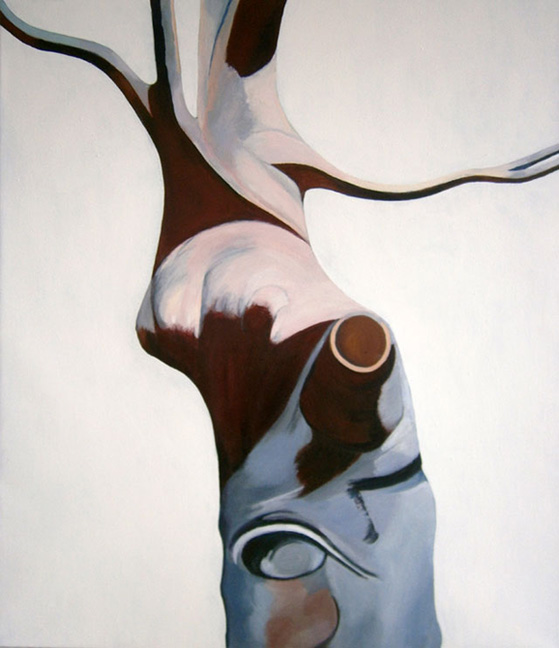
Facing Front 2008/14 Acrylic on Linen 38 x 44″
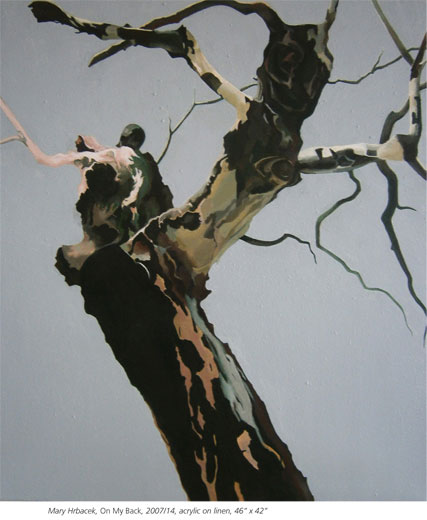
As a result, there is a tension between the realism of what we see and the nonobjective implications pushed forward quite subtly by the artist. The background of Facing Front is white, so that the form of the tree feels nearly frozen in space. On My Back (2007-14) is a more complicated picture, with the paint skillfully working out a vision of the texture and eccentric forms of a tree that is again leafless and looks quite aged. On My Back shows us that the angular trunk, moving toward the left but then twisting to the right, and the welter of branches ranging from thick to thin, are compelling just as they are.
I have the feeling that Hrbacek does not alter in any large way the twists and turns of the trees she photographs. Again, if the colors and forms are isolated, the notion that this painting is abstract becomes visually believable. As for the tree, it feels like it is damaged or dying, but this perception gives it a dignity that is meaningful. But we can only speculate on the condition of the tree, even as we comment on how effectively the image has been produced.
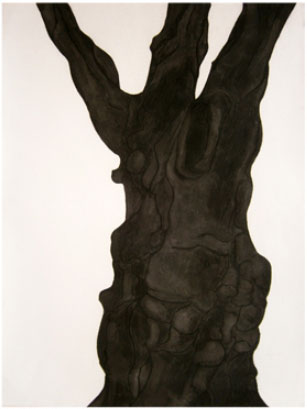 Mary Hrbacek, Body Love, 2014, charcoal on paper, 30″ × 22″
Horse Sense (2008-14) consists of a large trunk, painted light tan and dark brown, with two branches, each of them moving upward, in congruence with the thicker trunk in the middle of the painting. Structurally, it is a beautiful painting, with the branches moving first horizontally, away from the central form, and than angling upward. The contrast between light and dark makes for a remarkable display of tonal difference, which on one level is what Horse Sense is all about. A hazy blue sky occupies the background; the imagery is not really apocalyptic, although all three paintings mentioned here are denuded of foliage. Inevitably, we come to the realization that the isolation of the form may well comment on the damage we’ve done to the natural world.
But, to Hrbacek’s credit, there is not a trace of sentimentality in her art. Although the recognition of a permanent ecocide may exist in her art, at the same time, the three paintings exist as exemplary versions of nature. In a time when our abuse of nature borders on the apocalyptic, Hrbacek’s interest in these flawed but beautiful trees feels like a call to action, based in no small way on the skill with which she paints them.