
Finding a contemporary art gallery in NYC that offers truly original artwork requires looking past heavily marketed commercial spaces. The solution is targeting independent, artist-run studios where direct creator access ensures authenticity, transparent provenance, and investment-worthy pieces without paying steep blue-chip markups just for the zip code.
New York is saturated. Derivative pieces flood the market constantly. Finding original contemporary art in NYC takes a trained eye. You can’t just walk into a pristine white cube and assume brilliance kind of hangs on the walls or something. Most of the time it’s just slick marketing, very polished, very sure of itself. A sleek storefront does not necessarily guarantee value, and honestly, that part gets skipped. Often, it merely guarantees high overhead costs passed down to the buyer.
Why Is Authentic NYC Art Getting Harder to Spot?
The core issue is the rapid rise of art-as-content. Mass-produced aesthetics now masquerade as high art on a daily basis.
Consider a common scenario playing out every weekend across the city. A first-time buyer walks into a slick space in a high-rent district. They spend five figures on a generic resin pour simply because the venue poured free champagne and had perfect overhead lighting. They completely ignore the lack of foundational technique. The piece looks fantastic on a social media grid. Fast forward two years. The cheap material yellows. The sharp edges crack under apartment temperature shifts. The investment is entirely worthless.
Or picture a high-end staging project in Tribeca. A designer needs a massive statement piece for a luxury loft. They opt for a slick, geometric spray-paint canvas from a mega-gallery because the colors match the imported rug. The client moves in. Six months later, they attend a dinner party across town. The identical painting hangs in their friend’s dining room. Only the colors are inverted. The illusion shatters. The prestige evaporates immediately.
Here’s the reality. Sourcing NYC original artwork demands ignoring the superficial noise. Art collectors and interior designers must scrutinize the raw execution. It takes patience to look past the marketing budget. Authentic art speaks for itself. It does not need a DJ in the corner to make it interesting. The canvas should hold the weight of the room alone.
Many commercial spaces operate strictly on volume. They need to move inventory quickly to pay exorbitant leases. This breeds a culture of safe, repetitive creations. Artists get pressured to recreate their bestsellers endlessly. The initial spark dies. True originality gets replaced by an assembly line of predictable color palettes.
What Are the Hidden Markers of a Space That Promotes True Originality?
Spotting a space dedicated to serious artistic evolution requires a massive shift in perspective. High-turnover retail spaces operate like factories. They push whatever color combination trended online last month. They rely heavily on impulsive, uneducated buyers.
Boutique galleries and independent studio spaces operate completely differently. They care about the paint. They care about the sweat. They understand that a painting is a physical object, not just a flat image on a screen.
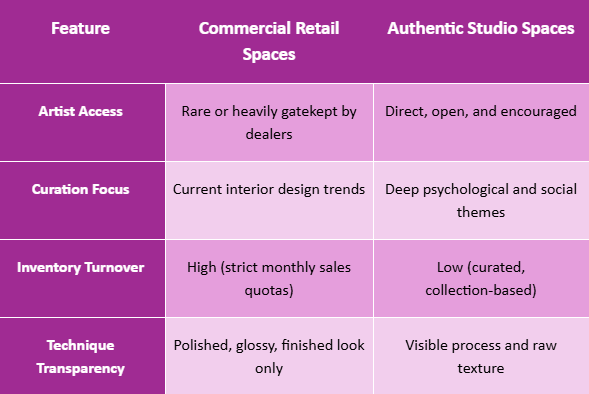
But there’s a catch. These independent spaces do not always have massive neon signs pointing to the front door. They require a bit of digging. You have to ask the right people. You need to read between the lines of exhibition press releases.
Do They Prioritize Process Over Production?
Valuable galleries always highlight the messy, physical reality of artmaking. They show off the charcoal layers hidden under thin glazes. You can see the raw canvas textures bleeding through the edges. Thick oil drying times matter more than quick sales quotas.
Look at it this way. It is all about intent. When an artist spends months building a psychological profile onto a canvas, the work breathes. It demands attention. Factory-style paintings just take up empty wall space. Authentic creators let the struggle show. They leave evidence of their hand. A perfect, machine-like finish often hides a profound lack of deep conceptual thought.
And interior designers know this secret well. A room filled with mass-produced furniture desperately needs a grounding element. An original painting provides that necessary friction. It stops the eye. It forces a conversation. Without it, a room feels like a hotel lobby. Sterile. Forgettable.
How Do You Filter Out the Noise When Buying in New York?
Interior designers and first-time buyers often need to source original work under immense pressure. Deadlines loom constantly. The client walls are completely empty. Panic buying is a massive mistake.
Worse still. Rushing the process always leads to acquiring expensive decor instead of genuine art.
To filter out the noise, you have to slow down the entire acquisition process. Refuse to be rushed by aggressive sales tactics. Keep these actionable steps in mind when evaluating a new creative space.
- Ask about the stylistic evolution of the creator over the last three years to ensure they are growing, not just repeating.
- Request to see the back of the canvas to check the raw stretching and look for structural integrity.
- Inquire about scheduling a direct studio visit to view the workspace and meet the mind behind the work.
Because an authentic space will welcome these questions with open arms. They thrive on educated buyers. A gallery pushing fast-fashion art will immediately deflect. They will quickly change the subject back to the price tag or the custom framing options. They want to close the deal today. An authentic space wants to start a decades-long relationship.
Sourcing contemporary art should feel like a discovery. It should not feel like a retail transaction at a department store. You are looking for a piece of human history. You want a slice of someone’s unique perspective captured in pigment and oil. That kind of magic does not happen in a vacuum. It happens in studios where creators push boundaries and take massive risks.
Why Consider an Artist-Run Gallery in New York City?
Stop judging a gallery by its front door. You need to know who stands behind the work. Artist-run and independent galleries give you a better shot at finding that answer because you can get closer to the person, process, and ideas behind the art. You are not just buying a polished object under bright lights.
Ask about the artist. Inquire how the work developed. Ask what changed between the first sketch and the finished piece. A serious space will welcome those questions instead of steering you straight toward a price tag.
That access changes the buying experience. When you visit an artist-led space, look for work with a clear point of view. Ignore pieces that simply copy whatever style dominates Instagram this month. You want work that feels specific, difficult to imitate, and rooted in years of actual practice.
Mary Hrbacek Studio Gallery offers that kind of direct connection to contemporary art in New York. The gallery gives you an opportunity to encounter Mary Hrbacek’s work through its distinctive visual language and psychological depth.
Don’t treat that difference as a small detail. When you buy original art, you want to know what makes the work belong to that artist. You should be able to see the choices, risks, marks, and ideas that separate it from a room full of decorative copies.
That is where an independent gallery earns its place. It helps you get past the showroom gloss and closer to the actual work. Take your time. Look closely. Ask better questions.
Mary Hrbacek Studio Gallery encourages that process. Congratulations, you have found the kind of New York art experience that commercial spaces cannot easily manufacture.
Where Will You Make Your Next Acquisition?
New York moves fast, and that speed can push you into bad buying decisions. You see a polished room, a famous neighborhood, and a wall full of expensive work. Your brain says, “This must be good.”
Ignore that impulse.
Visibility does not prove originality. A high price does not prove depth. A perfect showroom does not prove that the artist has anything meaningful to say.
Just slow down a bit and try to see the human hand behind it. Don’t rush, visit independent and artist-led galleries. When you’re there, ask questions about the artist process, their influences, what materials they use and where the creative direction is heading.
Mary Hrbacek Studio Gallery gives you that opportunity to look even closer at contemporary art through a distinctive voice that feels artful and also psychologically deep. Instead of treating art like just another interior decoration item, you can sit with it, and spend some time with work that has its own identity, not something generic or interchangeable.
Frequently Asked Questions
Should first-time buyers focus on emerging or established artists?
Focus primarily on the quality of execution. Mid-career and emerging creators often provide better investment upside and more direct access than heavily inflated established names.
Is the main gallery district always the best place for original art?
No. High rents force commercial spaces to push safe, trend-heavy inventory. Independent spaces and studios in outer neighborhoods often house bolder, riskier creations.
What makes an artwork truly investment-worthy?
A clear, distinct voice. Strong foundational technique, high-quality archival materials, and a consistent exhibition history all contribute heavily to lasting secondary market value.
Can I request direct studio access before buying?
Absolutely. Serious spaces encourage it. Meeting the creator and seeing the physical workspace confirms authenticity and builds a lasting emotional connection to the piece.
Latest Post
- The Emotional Power of Nature Paintings: Why They Never Go Out of Style
- The Reason High-End Art Buyers Are Returning to Charcoal Drawings on Paper
- How to Find a Contemporary Art Gallery in NYC That Offers Truly Original Artwork
- How Contemporary Nature Paintings Are Transforming Luxury Living Spaces in 2026
- What Makes Tree of Life Wall Art So Emotionally Powerful in Interior Spaces
- Collectors Are Quietly Choosing Charcoal Drawings Over Digital Prints
- The Unexpected Calm Contemporary Tree Paintings Bring Into Modern Homes
- Why Nature Paintings Feel More Personal Than Traditional Wall Art
- What Makes Charcoal Drawing on Paper So Magical?